

For the American industrial worker and the proud military veteran, the concepts of hard work and self reliance are not just values; they are a way of life. You spent decades building the infrastructure of this country or defending its interests abroad. You took pride in your trade, showed up early, and did the heavy lifting without complaint. Now, facing a diagnosis related to asbestos exposure, a new and uncomfortable conflict often arises. You might hear terms like “compensation,” “claims,” or “trust funds,” and your first instinct might be to recoil. For a generation raised on the idea that you don’t look for a handout, the idea of seeking financial support can feel like a compromise of your character. However, understanding the legal rights for asbestos victims requires a fundamental shift in perspective. This is not about a windfall or a handout; it is about an earned benefit that was set aside specifically because your hard work was performed under conditions that were known to be hazardous by the companies you served. It is the final “paycheck” for a career spent in the service of others.
The Difference Between a Handout and an Earned Compensation Benefit
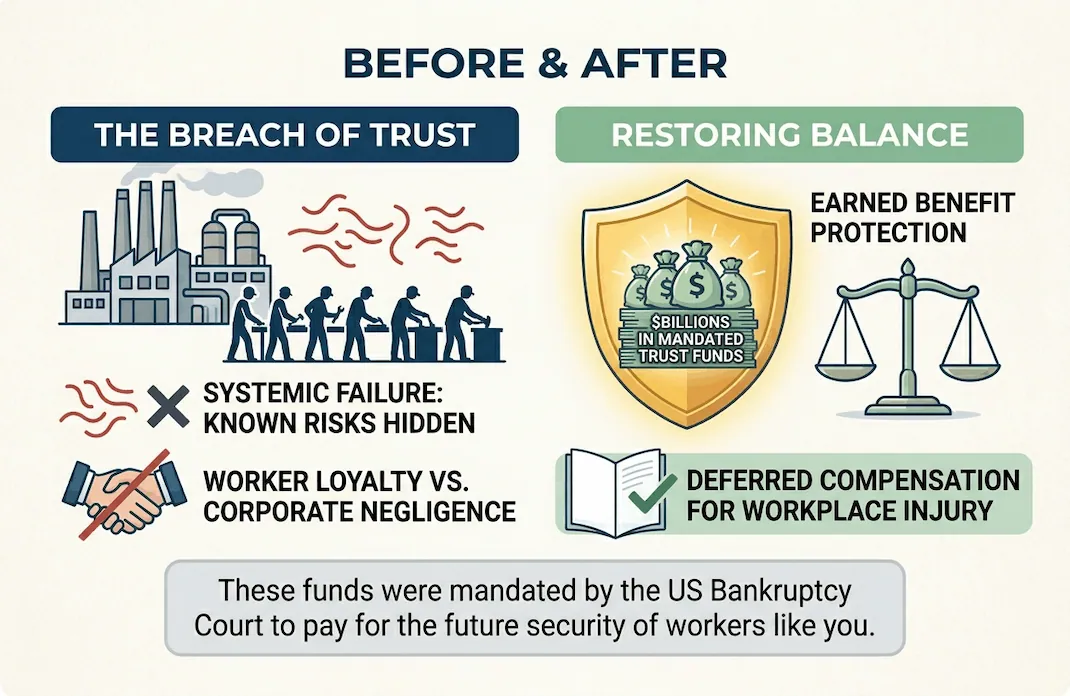
To understand the philosophy of asbestos trust funds, we must first define what they are not. They are not government welfare programs, and they are not a form of charity. Instead, these funds represent a pre-funded insurance policy created by the very corporations that manufactured, sold, or used asbestos products. When these companies faced the reality of the harm their products caused, the American court system required them to set aside billions of dollars in “Chapter 11” bankruptcy trusts. These funds were designated specifically to pay for the future healthcare and security of the workers who were unknowingly put at risk. Viewing these funds as a handout is a misunderstanding of their origin. In reality, this is deferred compensation for a workplace injury that took decades to manifest. You essentially “paid” for this benefit through years of loyal service in environments that were less safe than you were led to believe. This money belongs to the workers, not the corporate balance sheets.
You earned your benefits through years of hard work. Secure your family’s future today.
When a veteran receives a VA disability check, they do not view it as a handout; they view it as a recognition of their service and the physical toll that service took on their body. Asbestos trust funds operate on the exact same moral and philosophical ground. They are a recognition of your industrial service and the physical toll that asbestos has taken on your respiratory health. By accessing these funds, you are simply completing the “contract” that should have protected you years ago. You are collecting on a debt that is owed to you and your family for the risks you were asked to take without proper warning or protection. This is about identifying asbestos exposure sources and holding the legacy of those manufacturers accountable to the workers they relied upon for their success. By securing these funds, you are ensuring that the corporate accountability process reaches its rightful conclusion.
Why Proud Workers Hesitate to File an Asbestos Claim
Many veterans and tradespeople hesitate to move forward because they do not want to be “litigious.” You may have spent your whole life avoiding the courtroom, and the idea of “suing” feels contrary to your nature. It is vital to understand that filing a claim with an asbestos trust fund is not a lawsuit in the traditional sense. You are not dragging a local business owner into court, and you are not testifying against your former foreman or the company you may still feel a sense of loyalty toward. The companies involved have already admitted liability and have already been ordered by the courts to set this money aside. The funds are managed by independent trustees whose sole job is to distribute the money to qualified workers based on established medical criteria. The process is administrative, not adversarial. It is designed to be a respectful way to receive the support you have earned without the stress of a traditional trial or the public nature of a lawsuit.
The Concept of Corporate Accountability vs. Personal Pride
Some workers feel that by taking the money, they are somehow admitting a weakness or looking for an “easy way out.” On the contrary, taking action is an act of accountability. By filing a claim, you are ensuring that the billions of dollars set aside by these corporations actually go to the people they were meant for, rather than sitting in a bank or being absorbed back into corporate interests or legal fees. It is a way of standing up for yourself and for the brotherhood of workers who stood beside you on the job site. If you don’t claim what was set aside for you, the negligence of the past goes unaddressed. According to the U.S. Department of Justice, the transparency and integrity of these trusts are paramount to ensuring justice for workers who were harmed by toxic exposure:
“Asbestos trusts are created through the bankruptcy process to ensure that funds are available to pay the claims of individuals who have been injured by asbestos exposure, providing a critical path to compensation outside of the traditional litigation system.”
Protecting the Family Legacy After Mesothelioma
For most proud workers, the motivation for any major life decision is the protection of their family. You worked those long shifts, took those double time assignments, and accepted dangerous tasks so that your spouse would be taken care of and your children would have a better start than you did. An asbestos related diagnosis can threaten that entire legacy. The costs of specialized medical care, travel to top tier cancer centers, and the loss of household contributions can quickly drain a lifetime of careful savings and pensions. Refusing to access trust fund benefits out of a sense of individual pride can accidentally put a massive financial burden on the very people you have spent your life trying to protect. Accessing these funds is an extension of your role as the provider; it is the final way you can ensure your family’s financial stability is not compromised by a disease you did not choose to have.
Leaving a War Chest for Your Spouse and Children
Think of the trust fund compensation as a “war chest” for your family’s future. This money can be used to cover the mortgage, pay for the grandkids’ education, or ensure that your spouse has a comfortable retirement regardless of the medical expenses that may arise during your treatment. When viewed through the lens of family advocacy, the decision to file a claim becomes much clearer and more honorable. It is not about you; it is about them. It is the fulfillment of your promise to look after your own, even when you are no longer the one bringing home a weekly paycheck. By navigating the VA benefits for asbestos alongside trust fund claims, you are maximizing the resources available to your household, ensuring that your hard earned legacy remains intact and unburdened by debt or medical collectors.
The Ethics of the Asbestos Industry and the Right to Recovery
It is also helpful to consider the ethics of the industry that led to the creation of these trust funds. Internal documents from many asbestos manufacturers revealed a disturbing truth: they knew about the health risks as early as the 1930s and 1940s. Despite this knowledge, they continued to sell their products without warning labels and without providing workers with adequate respiratory protection or safety training. They chose quarterly profits over the safety of the men and women in the shipyards, refineries, and construction sites. This historical context is important because it removes any “guilt” a worker might feel about seeking compensation. These companies did not show you the same loyalty that you showed them. The trust funds are the legal remedy for that breach of trust. You are not “taking” something; you are recovering what was lost due to calculated corporate negligence. This is a matter of restoring the balance of justice.
Understanding this history allows you to view the NIOSH guidelines on asbestos safety with a new perspective. For decades, the safety standards we take for granted today simply did not exist because corporations fought against them to save on costs. If you were exposed while serving in the Navy or working in a power plant, you were a victim of a systemic failure to protect human health. Seeking an earned benefit is the logical conclusion to a career spent in a hazardous environment. It is the final step in a long journey of work, and it is a step you should take with your head held high, knowing you are simply reclaiming what was always yours by right of your labor and your injury.
Moving Forward with Dignity and Clarity
Deciding to explore your eligibility for an asbestos trust fund is a significant moment of transition. It marks the point where you stop being a victim of the past and start being the architect of your family’s future security. You can move forward with the dignity of knowing that you are not asking for a handout, but rather asserting your right to a benefit that was earned through sweat, service, and sacrifice. The process is confidential, respectful, and focused on providing you with the resources you need to focus on what matters most: your health and your loved ones. You have spent your life taking care of everyone else. Now, it is time to allow the systems put in place by the law to take care of you. Reach out to MesoCare to learn more about how to access the support you have rightfully earned through a lifetime of honest work.
Trust Fund Vital Statistic:
There are currently more than 60 active asbestos trust funds in the United States, with a combined estimated value of over 30 billion dollars. These funds were specifically mandated by federal courts to ensure that workers exposed to asbestos have access to the medical and financial support they earned through their labor. Source: RAND Corporation Research Report
Medical Disclaimer: MesoCare.org provides educational information and is not a medical provider. We are not doctors. This content is not intended to be a substitute for professional medical advice, diagnosis, or treatment. Always seek the advice of your physician with any questions regarding a medical condition. Treatments mentioned are options that may help and should be discussed with a specialist.
Legal Disclaimer: MesoCare.org is a resource center and advocacy group, not a law firm. We do not provide legal advice or guarantee specific financial outcomes. No attorney-client relationship is formed by using this site or contacting an advocate. Potential compensation or grant amounts are estimates and vary by individual case.