
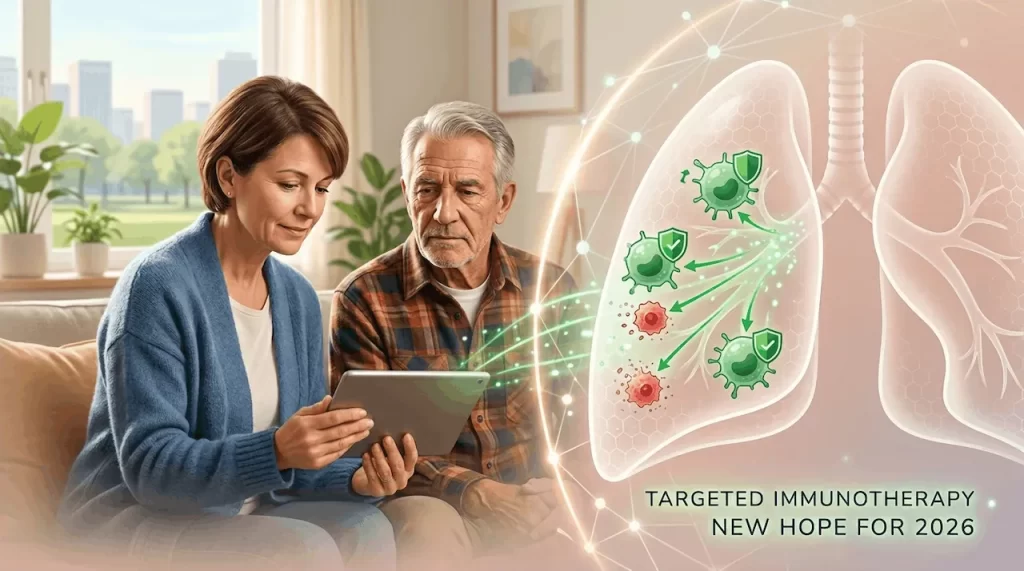
You’re sitting in a small exam room, the air feels a little too thin, and a doctor is using words like “checkpoint inhibitors” and “biomarkers.” It feels like you’re being asked to learn a second language while your world is spinning. At MesoCare, we know that moment. We know the look on a daughter’s face when she’s trying to scribble notes in a marble notebook, and the way a husband stares out the window, wondering how a career in a shipyard led to this quiet room. You aren’t looking for a miracle; you’re looking for a plan that makes sense. That is where immunotherapy comes in.
In 2026, we’ve moved past the era where “slash, burn, and poison” were the only tools in the shed. Immunotherapy is often called a “smart” treatment because it doesn’t just blindly attack your body. Instead, it acts like a specialized trainer for your immune system, teaching it to spot the mesothelioma cells that have been “cloaking” themselves to stay invisible. Understanding the latest mesothelioma treatment options is a powerful first step in moving from a state of shock to a state of action.
What is Immunotherapy and How Does It Fight Asbestos-Related Cancer?
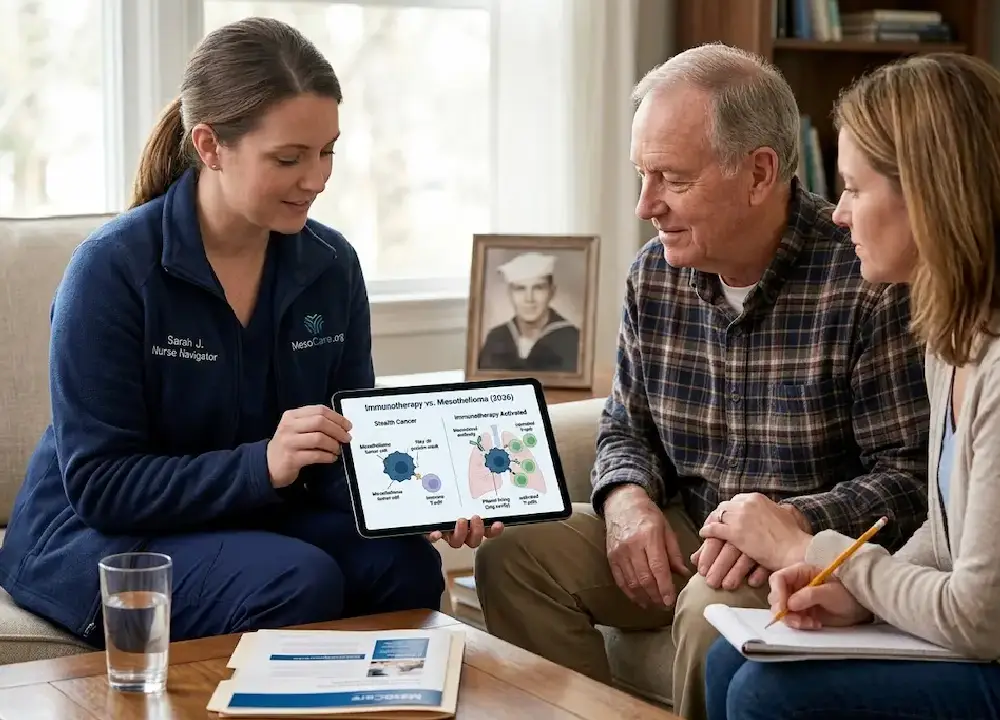
To understand immunotherapy, think of your immune system as a high-tech security team. Usually, this team is great at spotting intruders like viruses or bacteria. However, mesothelioma is a “stealth” cancer. It produces specific proteins that act like a fake ID, telling your immune cells, “Move along, nothing to see here.”
Immunotherapy drugs, primarily known as monoclonal antibodies, strip away that disguise. By blocking the “off switches” (checkpoints) on your immune cells, these drugs allow your body to realize that the tumor shouldn’t be there. In 2026, we are seeing more targeted versions of these drugs that focus specifically on the pleural lining or the peritoneal cavity, reducing the impact on healthy organs.
You are not alone. Managing the costs of advanced care is a major burden for many families. Check your eligibility for financial aid and grants to help cover medical bills and travel for specialized care.
The Standard of Care in 2026: Dual Immunotherapy
For many years, chemotherapy was the only option. Today, the “Gold Standard” for many patients who cannot have surgery is a combination of two drugs: Nivolumab (Opdivo®) and Ipilimumab (Yervoy®).
This “dual-action” approach is unique. One drug helps your T-cells recognize the cancer, while the other helps those T-cells multiply and stay active longer. This combination has been a game-changer for those with “non-epithelioid” mesothelioma, which is a cell type that historically was very difficult to treat with traditional chemo. In 2026, doctors are also fine-tuning the dosages of these combinations to ensure that patients can stay on treatment longer with fewer interruptions.
The Rise of First-Line Pembrolizumab
Another major player in 2026 is Pembrolizumab (Keytruda®). Originally used as a second-line defense, it is now frequently used right at the start of the journey. For families, this means having access to a treatment that is often administered in a comfortable infusion center rather than a sterile hospital ward, allowing for more time at home between sessions.
“Immunotherapy is fundamentally changing the way we approach cancers like mesothelioma. For many patients, it is offering durable responses and improved long-term survival that were once considered unachievable with traditional therapies.” — Dr. Julie Brahmer, Johns Hopkins Medicine
How Do Doctors Determine Eligibility for “Smart” Drugs?
Not everyone receives the same treatment plan. In 2026, “Precision Medicine” is the guiding light. Before starting any therapy, your medical team will perform a detailed analysis of your cancer’s DNA. This is often called molecular profiling.
The Role of Biomarkers
A biomarker is essentially a chemical fingerprint. The most famous one for mesothelioma is PD-L1. If your tumor has high levels of PD-L1, it’s like having a target painted on the cancer wherein the immunotherapy knows exactly where to go. Even if your levels are low, however, 2026 research has shown that certain combinations can still be highly effective. This is why getting a second opinion from a specialist who understands these diagnostic biopsy results is so critical.
Understanding Your Cell Type
Whether your diagnosis is pleural (lung lining) or peritoneal (abdominal lining), and whether your cell type is epithelioid, sarcomatoid, or biphasic, dictates the strategy. In 2026, we are seeing breakthroughs specifically for the sarcomatoid type, which was previously resistant to most drugs but is now showing remarkable sensitivity to new “smart” combinations.
New Frontiers: Clinical Trials and Emerging Therapies
Beyond the standard FDA-approved drugs, 2026 has brought several “next-generation” therapies into clinical trials. For many families, these trials are not a “last resort” but a way to access the medicine of 2030 today.
- Cancer Vaccines: Unlike a flu shot, these “therapeutic vaccines” are designed to treat existing cancer. The UV1 vaccine, for example, has shown promise in “priming” the immune system before the main treatment begins.
- CAR T-Cell Therapy: This involves taking your own immune cells, “supercharging” them in a lab to recognize mesothelioma, and putting them back into your body. It is highly technical but offers a level of precision we have never seen before.
- Enzyme Therapy: New treatments like ADI-PEG20 are being used to starve cancer cells of the nutrients they need to grow, often used in tandem with immunotherapy to provide a “one-two punch.”
Navigating clinical trial options can be exhausting for a caregiver. Our Patient Advocates can help you filter these trials by location and eligibility so you don’t have to do the heavy lifting alone.
Managing Side Effects: The “Immune-Related” Difference
If you have experience with chemotherapy, you might expect hair loss and severe nausea. Immunotherapy is different. Because it “wakes up” the immune system, the side effects usually involve inflammation. It’s less about feeling “poisoned” and more about your body feeling like it has a mild, persistent flu.
What to Watch For
The most common issues include fatigue, skin rashes, and joint pain. However, it is vital to watch for “itis” symptoms which means inflammation of organs. For example, colitis (gut inflammation) or pneumonitis (lung inflammation). In 2026, we have very effective protocols to manage these with steroids, often without having to stop the cancer treatment entirely. The key is early communication with your “Nurse Navigator” or oncology team.
Practical Home Care Tips
For the caregiver, keeping a daily log of symptoms is the best tool you have. A slight cough or a new patch of itchy skin might seem minor, but in the world of immunotherapy, it’s a signal that the immune system is working and perhaps needs a little adjustment.
The Financial Roadmap: Accessing Grants and Support

We often hear from Veterans who don’t want “charity.” We want to be clear: the funds available for mesothelioma patients are not handouts. They are compensation funds set aside by companies that knew asbestos was dangerous. This is your earned right to support.
In 2026, the cost of immunotherapy can be high, but between Asbestos Trust Funds, VA benefits, and manufacturer patient assistance programs, very few families should have to pay for these treatments out of pocket. Our advocates specialize in helping you piece together this financial puzzle so you can focus on the next appointment, not the next bill.
Conclusion: Moving Forward with Confidence
Mesothelioma is a heavy burden, but in 2026, you aren’t carrying it with the same limited tools we had a decade ago. “Smart” treatments are turning a once-unmanageable diagnosis into a condition that can be treated with precision and dignity. Whether you are looking for a specialist, curious about a specific drug, or need help navigating the financial side of care, remember that you don’t have to do this alone. At MesoCare, we are here to walk this path with you, one step at a time.
2026 Treatment Update:
As of early 2026, more than 100 active clinical trials are currently recruiting mesothelioma patients for immunotherapy-based research. Data from these trials has shown that dual-immunotherapy combinations can increase the two-year survival rate to approximately 41%, compared to just 27% for those on traditional chemotherapy alone. (Source: National Cancer Institute)
Medical Disclaimer: MesoCare.org provides educational information and is not a medical provider. We are not doctors. This content is not intended to be a substitute for professional medical advice, diagnosis, or treatment. Always seek the advice of your physician with any questions regarding a medical condition. Treatments mentioned are options that may help and should be discussed with a specialist.
Legal Disclaimer: MesoCare.org is a resource center and advocacy group, not a law firm. We do not provide legal advice or guarantee specific financial outcomes. No attorney-client relationship is formed by using this site or contacting an advocate. Potential compensation or grant amounts are estimates and vary by individual case.