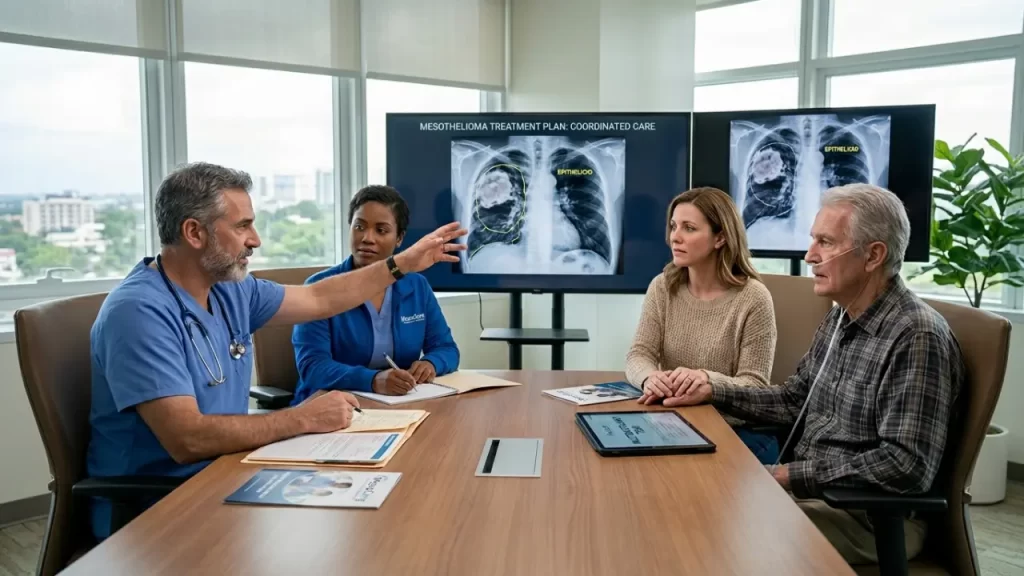
A diagnosis of mesothelioma often feels like being cast out into a stormy sea without a compass. For many families, the initial shock is followed by an overwhelming sense of isolation. You may feel as though the weight of every medical decision rests solely on your shoulders or that you are bouncing between disconnected doctors who do not speak the same language. However, the modern standard of excellence in cancer care has evolved to solve this exact problem. Today, the most effective way to manage this condition is through a “Treatment Village” approach. This model ensures that you are never alone in the decision making process. By understanding how mesothelioma specialized medical care functions, families can move from a state of high anxiety to a state of structured, supported action. This specialized coordination is designed to lift the burden of logistics off the family so they can focus on what matters most: healing and time together.
What is a Multidisciplinary Mesothelioma Team?
The term “multidisciplinary team” might sound like medical jargon, but its meaning is simple: it is a group of diverse experts who work together as a single unit to care for one patient. In the past, a patient might see a surgeon, then weeks later see an oncologist, and later still talk to a radiation expert. These doctors often worked in silos, leaving the patient to act as the middleman, carrying records from one office to another and trying to explain what the previous doctor said. In a specialized mesothelioma program, these barriers are removed. The team typically includes thoracic surgeons, medical oncologists, radiation oncologists, radiologists, and pathologists who all specialize specifically in asbestos related diseases. Because mesothelioma is a complex and rare cancer, having a team that looks at the same problem from five different angles ensures that no detail is missed and no stone is left unturned. This prevents the “trial and error” approach often found in general hospitals.
Don’t let medical expenses stand in the way of world-class care.
This collaborative approach is the gold standard because it acknowledges that mesothelioma does not affect just one part of your life. While the surgeon focuses on removing the visible tumor mass, the medical oncologist focuses on systemic treatments like chemotherapy or immunotherapy to target microscopic cells that the eye cannot see. Meanwhile, the radiation oncologist looks at how to prevent the cancer from returning in specific areas using targeted energy. This coordination happens behind the scenes in real time, so the family experiences a seamless transition from one phase of treatment to the next. By utilizing advanced diagnostic imaging for asbestos, this team creates a comprehensive blueprint for your health that is far more accurate than any single doctor could produce in isolation. It turns a fragmented medical journey into a singular, focused mission.
The Power of the Mesothelioma Tumor Board
One of the most comforting aspects of a specialized village is a formal meeting known as the “Tumor Board.” If you are a patient, you will likely never sit in this room, but your case is the guest of honor. A Tumor Board is a scheduled conference where ten to twenty specialists gather in a single room or secure digital space to review specific patient cases. They pull up your scans on large high definition screens, review your pathology reports together, and debate the best course of action. This is essentially a built in second, third, and fourth opinion provided automatically. Instead of you having to travel across the country to get different perspectives from different institutions, the different perspectives come together in one room to advocate for you. This collective brainpower is what leads to innovative treatment plans tailored to your specific cell type, whether it be epithelioid, sarcomatoid, or biphasic.
How Collective Expertise Improves Patient Outcomes
When specialists collaborate, they are able to catch subtle nuances that might be overlooked in a standard hospital setting where mesothelioma is rarely seen. For example, a pathologist who sees thousands of asbestos cases a year might identify a specific genetic marker that responds better to a new clinical trial. The oncologist can then immediately discuss how to integrate that trial into your current regimen without you having to ask for it. This real time communication reduces the “wait time” between diagnosis and treatment, which is critical for aggressive cancers like pleural mesothelioma. According to the National Cancer Institute, this level of expert oversight is foundational to modern oncology and patient safety:
“Multidisciplinary consultation is a key component of quality cancer care, ensuring that all patients benefit from a comprehensive review by a team of experts who provide a personalized treatment recommendation based on the latest scientific evidence.”
Beyond Doctors: The Supportive Roles in Your Village
A true treatment village extends far beyond the physicians in white coats. Mesothelioma affects the entire family unit, including the spouse, children, and grandchildren, which means the support system must be equally broad. Specialized centers include nurse navigators, social workers, and oncology dietitians as core members of the team. The nurse navigator is often the most important person in your village; they serve as your single point of contact, helping you schedule complex appointments, explaining complex medical terms in plain English, and ensuring your questions are answered promptly. They are the bridge between the high tech medical world and your living room, making sure the “village” feels accessible and warm rather than intimidating or clinical.
Addressing the Emotional and Practical Needs of Caregivers
Social workers within the mesothelioma team provide a different kind of medicine that is just as vital. They help families navigate the practical burdens that come with a chronic illness, such as finding local lodging near a major treatment center, coordinating transportation, or identifying financial assistance programs. They recognize that if a caregiver is burnt out, overwhelmed, or financially stressed, the patient’s health and recovery can suffer. By including these professionals in the multidisciplinary fold, the medical team ensures that the “home front” is as stable as possible. This holistic view is what differentiates a standard community hospital experience from a world class specialized mesothelioma program. It transforms the experience from “managing a disease” to “supporting a family” through their most difficult hour.
The Role of Clinical Trials and Innovation
In a coordinated village, the door to the future is always open. Because mesothelioma is the focus of intense global research, new therapies are emerging at a faster rate than ever before. A multidisciplinary team is best positioned to identify when a patient might be a candidate for a clinical trial involving immunotherapy or gene therapy. Instead of treatment being a static “one size fits all” plan that never changes, it becomes a dynamic process that evolves with the science. If one treatment path is not yielding the desired results, the entire team can pivot together to explore the next available innovation. This proactive stance gives families a genuine sense of hope, knowing that they are tapping into the very cutting edge of what is medically possible in the 21st century.
Furthermore, these specialized teams often participate in national registries and research databases. This means that the data from your care helps the next generation of patients, and in return, you benefit from the collective data of thousands who came before you. This sense of being part of a larger mission can be incredibly empowering for patients who want their journey to have a lasting impact on the world. When you join a specialized treatment village, you are not just a patient on a chart; you are a partner in a global effort to improve the prognosis for mesothelioma victims and their families. This connection to a larger purpose can provide significant emotional strength during difficult days.
The Family as the Heart of the Team
While the doctors provide the technical expertise, the family remains the heart of the village. A coordinated team respects the values, goals, and personal wishes of the patient above all else. Decisions are not made for you; they are made with you. Whether your goal is to undergo aggressive surgery to maximize time for a specific milestone, such as a wedding or graduation, or to focus on palliative care to maximize daily comfort, the village adjusts its entire strategy to meet your specific needs. This patient centered approach ensures that your dignity and voice remain the top priority throughout the entire medical process. Communication is kept open, honest, and frequent, removing the “black box” of medical decision making that causes so much unnecessary anxiety in general healthcare settings.
Moving Forward with Confidence
The journey through a mesothelioma diagnosis is never easy, but it does not have to be a lonely one. By seeking out a specialized treatment center that utilizes a multidisciplinary team and a formal Tumor Board, you are surrounding yourself with a fortress of expertise and empathy. You are gaining a team of dedicated advocates who spend their professional lives thinking about how to help you. This coordination provides the clarity you need to make difficult choices and the steady support you need to keep moving forward one day at a time. You have spent your life looking out for others and building your own community; now, it is time to let this specialized village look out for you. To begin building your own support network and explore the resources available for your family’s future, reach out to MesoCare for guidance on the next steps of your journey.
Medical Coordination Fact:
Research indicates that patients treated by a multidisciplinary team at a high volume cancer center experience significantly better outcomes and higher rates of survival compared to those treated in a general hospital setting. This is largely due to the specialized focus on rare cell types and the rapid integration of new therapies. Source: Journal of Thoracic Oncology
Medical Disclaimer: MesoCare.org provides educational information and is not a medical provider. We are not doctors. This content is not intended to be a substitute for professional medical advice, diagnosis, or treatment. Always seek the advice of your physician with any questions regarding a medical condition. Treatments mentioned are options that may help and should be discussed with a specialist.
Legal Disclaimer: MesoCare.org is a resource center and advocacy group, not a law firm. We do not provide legal advice or guarantee specific financial outcomes. No attorney-client relationship is formed by using this site or contacting an advocate. Potential compensation or grant amounts are estimates and vary by individual case.